Why One Heavy Item Can Unbalance a Washing Machine
On this page (17 sections)
- How One Wet Item Shifts the Load
- Wet Weight Matters More Than Dry Size
- Why Both Washer Styles Need a Centered Load
- Spin Speed Magnifies an Off-Center Mass
- Bunched Fabric Can Hold Even More Water
- Pocket Contents Add Concentrated Weight
- Use Bulky Cycles Only When the Manual Allows Them
- Read the Signs of a Washer Trying to Redistribute
- Thumps, Walking, and Incomplete Spin Are Different Warnings
- Weighted Blankets Require Exact Limits
- Never Hold Down or Override a Shaking Washer
- Pause and Wait for All Motion to End
- Choose Balancing Items by Compatibility, Not Weight Alone
- Separate Normal Rebalancing From Stop-Now Signs
- Heavy-Item Safety Checklist
- Conclusion
- Frequently Asked Questions
One heavy item can unbalance a washer when most of its wet weight gathers on one side of the basket. There may be plenty of empty space, yet the machine still struggles to distribute that weight before spinning.
A soaked blanket behaves differently from several separate shirts. A small load is not automatically too small; see this guide to washer underloading. The shirts can spread around the drum; the blanket may stay folded into one dense piece. Adding more laundry isn’t automatically the answer, because the added items must suit the fabric, cycle, and washer’s loading instructions.
- A small-looking load can still have an uneven weight distribution.
- Absorbent items can become much harder to handle after washing.
- Slow redistribution attempts aren’t the same as violent banging.
- A Bulky cycle doesn’t make every heavy object machine washable.
- Stop unsafe movement through the controls, then wait for the lock to release.
Before retrying a wet item, work out whether the problem is its position, its suitability for the machine, or a fault affecting ordinary loads too. That distinction can save another unsuccessful spin and prevent unsafe lifting.
How One Wet Item Shifts the Load
A washer spins most smoothly when the rotating load is reasonably distributed around its axis. If one saturated item stays on one side, its weight pulls the rotating assembly away from that balanced arrangement.
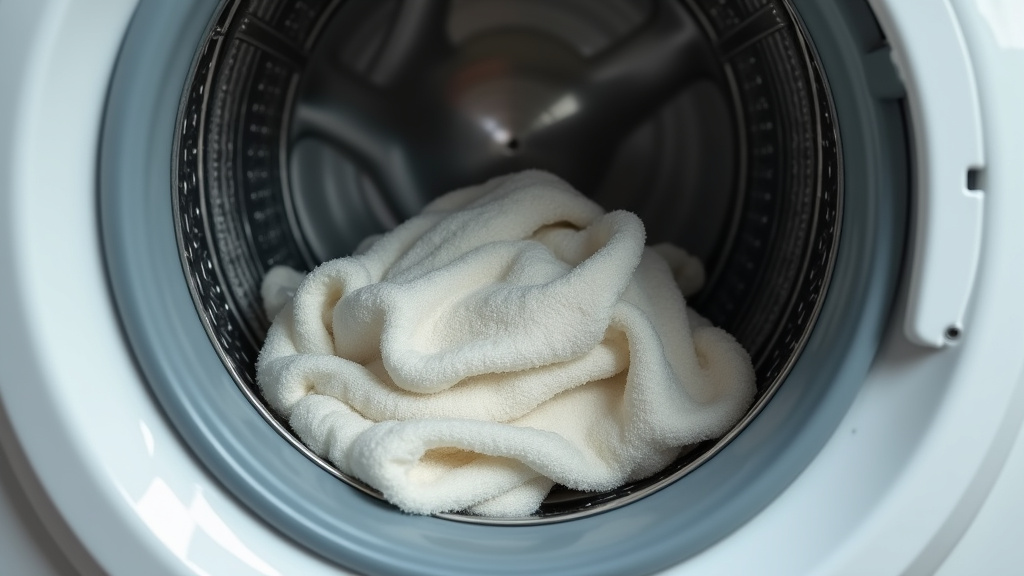
Imagine a blanket folded tightly into a lump rather than spread around the basket. The washer can move the lump, but it cannot guarantee the blanket will open and settle evenly. Empty space on the opposite side doesn’t provide a counterweight.
This is why an imbalance message doesn’t necessarily mean the washer is overloaded. The total amount can be small while its distribution is poor. Whirlpool identifies single bulky or highly absorbent items as a possible cause of shaking.
Wet Weight Matters More Than Dry Size
A dry item’s bulk is useful for judging room, but it doesn’t reveal how much water the material will retain. A thin synthetic throw and a thick cotton blanket can have similar dimensions while producing different wet loads.
There is no universal multiplier for wet weight. Construction, filling, and water retention differ. Use the manufacturer’s item restrictions and load limits.
Consider removal before starting, too. If you could barely lift an item while dry, a stopped wash may leave something you cannot safely support. Washing suitability includes safe handling, not just whether you can get the lid closed.
Why Both Washer Styles Need a Centered Load
Front loaders tumble clothing during washing, while top loaders use their own basket and wash-mechanism movements. Both still have to accelerate a rotating clothes container for extraction.
Neither opening style guarantees that every heavy piece will spin properly. Follow the loading pattern for the exact model.
In particular, don’t wind a long blanket tightly around a top loader’s center post. In a front loader, don’t push a dense bundle against the back just to clear the doorway. Placement should preserve movement rather than turn the item into a fixed mass.
Spin Speed Magnifies an Off-Center Mass
A load may seem quiet during washing and become troublesome only as spin begins. The effects of uneven rotating weight become more pronounced as speed increases.
The controls may slow the basket, try a different arrangement, or finish without reaching the usual extraction speed. Selecting the highest spin again doesn’t remove the original cause.
If a lower speed is offered for that fabric, it may be appropriate under the manual, but it isn’t a repair for severe vibration. Also expect a gentler permitted spin to leave more moisture. Plan a suitable drying method instead of treating maximum extraction as a requirement for every item.
Bunched Fabric Can Hold Even More Water
Large fabric can fold over itself, create pockets, or gather into a tight roll. Water and wash solution may remain between layers rather than moving away as freely as they would from separated clothing.
Open out a suitable blanket before loading and check that it isn’t wrapped around another item. Follow the washer’s instructions for arranging bedding rather than starting with a ball taken straight from the hamper.
If the same item repeatedly bundles despite correct preparation, more restarts aren’t a useful experiment. It may need a different approved program, a larger suitable machine, or an alternative cleaning method. The item and washer instructions determine which option is reasonable.
Pocket Contents Add Concentrated Weight
With coats, work clothing, or other pocketed items, empty the pockets before you think about balance. Coins, tools, and loose attachments can cause impacts and damage even when the overall laundry weight is acceptable.
Don’t dismiss metallic knocking as normal heavy-load noise. Stop safely and inspect only accessible areas after normal lock release.
If an object has disappeared through a gap, don’t fish for it with wire or reach beneath the appliance. Record what is missing and seek the appropriate service guidance. A loading adjustment cannot correct a foreign object trapped in an inaccessible part of the machine.
Use Bulky Cycles Only When the Manual Allows Them
A Bulky or Bedding program may change wetting, movement, or extraction to suit approved large items. It cannot increase drum space or make prohibited materials safe.
Check restrictions particularly carefully for waterproof pieces, foam, rubber-backed mats, electric bedding, and items with unusual filling. A general instruction to machine wash doesn’t establish that every washer or cycle is suitable.
Read the program’s item list, not just its name. If the manual distinguishes a blanket from a comforter or restricts certain construction, keep that distinction. When the intended method is unclear, asking the item manufacturer is safer than using the most powerful-looking cycle.
Read the Signs of a Washer Trying to Redistribute
Brief pauses, slow turns, and repeated gentle starts can be part of balancing. On some models the display time changes while the machine works through those attempts.
Allow normal behavior described in the manual to progress. Interrupting every small movement can prevent the control from completing its assessment, while repeated cancel-and-restart cycles make the pattern harder to understand.
Record an actual imbalance code or a failure to complete. There isn’t one universal number of attempts that applies to every washer. The important difference is between controlled redistribution and hard impacts, walking, leaking, or another clearly unsafe symptom.
Thumps, Walking, and Incomplete Spin Are Different Warnings
Each symptom tells you something different. A rhythmic impact can accompany uneven loading, but noise alone doesn’t prove the item is the only cause. A walking cabinet also raises installation or support concerns.
Clothing can be unusually wet even without loud movement if the washer limited or skipped fast spinning. Check whether the program finished, what speed was selected, and whether water remains visibly pooled.
If ordinary correctly loaded washes now behave badly too, widen the question beyond the blanket. A leveling, installation, drainage, or internal problem needs its own assessment. Don’t keep testing heavy loads to decide which hidden part has failed.
Weighted Blankets Require Exact Limits
A weighted blanket isn’t interchangeable with ordinary bedding. Its filling adds weight before any water is absorbed, and the cover and inner blanket may have different care instructions.
Find the blanket’s stated care method and the washer’s relevant limit. If a published limit refers to dry laundry, don’t substitute a guessed wet-weight calculation; ask the manufacturer when the allowance is unclear.
Removing a washable cover may let you clean that cover separately without washing the weighted insert. A commercial washer is an option only if it permits the actual item. A bigger door by itself doesn’t establish permission to wash weighted, waterproof, or specially filled bedding.
Never Hold Down or Override a Shaking Washer
Don’t sit on the lid, brace the cabinet with your body, or try to hold a walking appliance in place. Those actions put you close to moving equipment without changing the load distribution.
Use the normal stop or pause control if it is safe to reach, and keep other people away. Leave safety locks intact even if finishing the wash feels urgent.
Never unplug from a wet area or reach behind a violently moving machine. If water or electrical danger prevents safe access, stay clear and obtain appropriate help. A blanket can wait; unsafe operation isn’t something to push through for the final minutes of a cycle.
Pause and Wait for All Motion to End
After stopping, wait for the basket to finish moving and for the lock to release normally. A change in motor sound doesn’t establish that it is safe to open.
The next step depends on the model and the remaining water. Follow its approved drain, redistribution, or unloading procedure rather than loosening a hose or pump filter to hurry things along.
Support a wet item as you lift it instead of pulling from one corner or trim. Don’t strain to remove something too heavy for you. If normal draining cannot complete or the item cannot be handled safely, leave the washer stopped and seek assistance rather than forcing the task.
Choose Balancing Items by Compatibility, Not Weight Alone
Some manuals recommend adding compatible items to help distribute a small uneven load. That is a model-specific approach, not permission to throw in any towel you can find.
Compare care method, color, lint, soil, and permitted temperature. A light towel may add lint to a dark fabric, and an absorbent companion can increase the total load beyond the allowed size.
If additional pieces are permitted, distribute them as instructed rather than stuffing them beside the heavy lump. Stop when the combined load becomes crowded. If safe compatibility and useful movement cannot both be achieved, a different cleaning arrangement is the better choice.
Separate Normal Rebalancing From Stop-Now Signs
Use the behavior you actually observe to choose a response. The table isn’t a diagnosis of the suspension, pump, or controls; it helps separate waiting from safe stopping.
| Observation | First response | Important limit |
|---|---|---|
| Quiet slow turns | Check normal redistribution guidance | Do not interrupt every attempt |
| Displayed imbalance error | Follow that model’s pause and load instructions | Do not clear the code before noting it |
| Hard impacts or walking | Stop through the controls if safe | Never brace the machine |
| Item still dripping | Check completion, settings, and drainage messages | Do not assume more speed is the answer |
If the permitted correction fails, save the cycle and item details for support rather than repeating the same setup.
Heavy-Item Safety Checklist
Before trying that item again, check whether you can answer these six points. An unresolved item restriction matters more than the desire to finish at home.
- The item label permits the intended cleaning method.
- The washer manual allows its type and size.
- Pockets and attachments have been checked.
- The item is arranged loosely on a suitable program.
- Any balancing pieces are permitted and compatible.
- You have a safe plan for stopping, unloading, and drying.
Note whether only this item causes trouble. That pattern can help when choosing where to wash it next time.
Conclusion
One soaked item can be difficult to spin because its weight stays together rather than spreading around the basket. Spare drum space doesn’t guarantee balance, and a faster setting doesn’t correct the distribution.
Check whether the item belongs in that washer, prepare it loosely, and use the permitted cycle. Add companion pieces only when the manual supports that approach and their care needs agree.
If the machine bangs severely or moves across the floor, stop safely and wait for normal lock release. When a permitted correction fails, choose suitable alternative care or get support instead of repeatedly restarting the same load.
Frequently Asked Questions
Can an almost empty washer still be unbalanced?
Yes. Imbalance concerns where the weight is concentrated, not just how much space is occupied. One absorbent item can gather on a single side while most of the drum remains empty.
Should I add towels whenever a blanket won’t spin?
Only if the washer’s instructions permit it and the towels are compatible with the blanket. Added items can create lint, care, or capacity problems, so they aren’t a universal fix.
Does an imbalance error mean the washer is broken?
Not necessarily. First follow the safe load checks for that code. Repeated errors with ordinary suitable loads, or unsafe movement after correction, warrant manufacturer or qualified service advice.
Will a lower spin speed solve the problem?
It may be an allowed choice for some loads, but it isn’t a guarantee or a substitute for correcting severe movement. Respect the care instructions and expect more moisture when extraction is reduced.
Can I wash a weighted blanket in a larger commercial washer?
Only when both the blanket and that machine permit it. Size alone doesn’t settle restrictions on filling, construction, or cleaning method; confirm the instructions before loading.


