Can a Washing Machine Be Underloaded? What to Know
On this page (17 sections)
- Define the Problem Before Calling It Underloading
- Read the Small-Load Instructions for Your Model
- Think About the Item After It Absorbs Water
- Do Not Confuse a Small Load With Low Water
- Add Companions Only When They Belong in the Load
- Reduce Detergent Without Guessing a Fraction
- Choose Quick Wash for Its Intended Task
- Treat One Delicate Garment as a Care Decision
- Do Not Use an Empty Drum to Justify a Heavy Special Item
- Allow Normal Redistribution to Finish
- Check Settings Before Blaming Wet Clothes on Load Size
- Make a Safe Correction After an Interrupted Spin
- Decide Whether to Wash Now or Wait for Compatible Laundry
- Compare Small Loads by Their Actual Challenge
- Use a Six-Step Small-Load Plan
- Conclusion
- Frequently Asked Questions
A washer can often handle a small compatible load, but a very small or single-item load may be difficult to distribute for spin. Underloading is not a universal minimum number of clothes; it is a question of what your machine and selected program can manage.
One lightweight shirt and one thick bath mat are both single-item loads, yet they can behave very differently when wet. Empty drum space alone doesn’t tell you whether either item should be washed that way.
- Check the manual for small-load and single-item instructions.
- Consider absorbency and construction as well as the number of pieces.
- Add balancing items only when permitted and compatible.
- Match detergent to the actual load instead of using a full-load habit.
- Distinguish normal redistribution from severe movement or a persistent error.
There is no need to fill every available gap. The useful goal is a load that receives its permitted cleaning routine and completes extraction appropriately, without creating fabric damage merely to make the drum look fuller.
Define the Problem Before Calling It Underloading
A small load is simply a limited amount of laundry. A problem appears when that amount or arrangement does not work with the machine’s routine, such as one wet item repeatedly failing to distribute for extraction.
Do not diagnose underloading from the view through the door alone. A few shirts may finish normally on an allowed program.
Ask what actually happened: did the washer reject a setting, stop with an error, leave unexpected moisture or move severely? Each observation points toward a different check. “The drum looked empty” is context, not proof that adding more clothes will solve the issue.
Read the Small-Load Instructions for Your Model
Look for a minimum load, single-item advice or a small-load program in the manual. Some manufacturers give a method for adding compatible pieces when a load cannot balance.
Those instructions do not necessarily transfer to a different washer. A compact front-loader, a large agitator machine and a sensing impeller model can handle the same laundry differently.
Also check the selected cycle. Its allowed items matter even when you are far below the machine’s overall capacity. Keep the relevant loading and troubleshooting pages available so you are not trying to interpret an unfamiliar error while a heavy wet item remains inside.
Think About the Item After It Absorbs Water
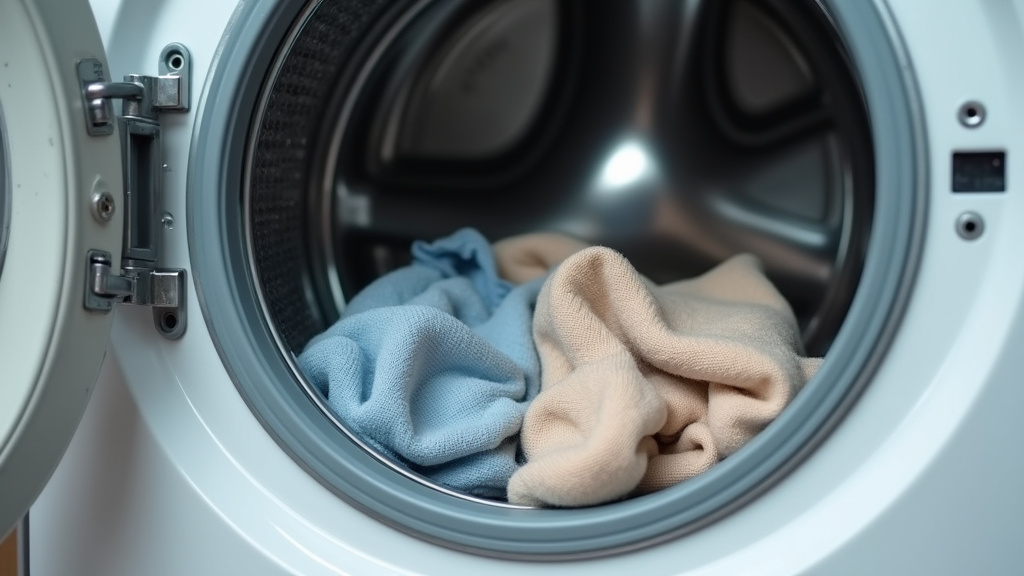
A thick absorbent object can become a substantial part of the rotating load. If it settles on one side, the washer may have difficulty arranging it for a faster spin.
Several separate compatible pieces give the machine a different distribution problem from one object of similar total mass. They can change positions independently, although that does not guarantee successful balancing.
You do not need a homemade calculation of saturated weight. Use the item’s construction and the manufacturer’s permission as decision aids. A light blouse, a filled cushion and a rubber-backed mat should not share one rule just because each could be washed alone.
Do Not Confuse a Small Load With Low Water
Automatic washers may adjust filling according to their program and sensing system. A small amount of laundry can be accompanied by little visible water without indicating a problem.
For HE models, a deep pool covering everything is not always the intended appearance. Follow the fill description for your exact machine rather than comparing it with a traditional top-loader.
Do not add buckets of water or more garments simply to change the view. If items remain dry or results are poor, review loading, the selected program and any error using the manual. Water appearance alone does not identify a failed sensor or establish the correct correction.
Add Companions Only When They Belong in the Load
If the manual calls for additional pieces, first compare care labels, color-transfer risk, texture, lint and soil. A suitable companion must be washable under the same conditions.
A clean towel is not automatically a good choice. It might shed onto dark clothing, abrade a fragile surface or require a different routine. Extra pieces should improve an approved arrangement without creating another problem.
Stay within the program’s upper limit as well. Moving from too few workable pieces to a tightly packed pile is not progress. If there is no compatible permitted companion, seek model-specific advice or use the item’s approved alternative method.
Reduce Detergent Without Guessing a Fraction
Use the detergent label’s guidance for the actual amount of laundry, soil and relevant water conditions. A capful used for the family towel load may be unsuitable for a few shirts.
Concentrations differ, so “a little less” is not a dependable measure across products. Use the supplied measuring system and check the machine’s HE requirement.
Do not cut, puncture or divide a detergent packet to create a smaller dose. Use it only as directed. For automatic dispensers, verify the concentration and settings rather than adding a separate manual dose. Keep all detergent secured away from children and pets, including while handling a small wash.
Choose Quick Wash for Its Intended Task
Quick Wash can be useful for a small, lightly soiled load when the garments and model instructions permit it. Small quantity alone is not enough to make the selection appropriate.
A single heavily soiled work garment may still need a different cleaning routine. A fragile item may require gentler handling, while a bulky object may be excluded from the quick program.
Read the cycle description rather than assuming the shortest time is the least demanding treatment. Some quick routines use different movement to clean within a shorter period. You are selecting a method for the fabric and soil, not merely filling the remaining time before you leave home.
Treat One Delicate Garment as a Care Decision
Check whether the item allows machine washing at all. A hand-wash-only label is not overruled by an almost empty drum, a mesh bag or a cycle named Hand Wash.
For an approved machine-washable delicate, use the allowed program and protective handling. A low-spin finish may leave more moisture intentionally, so compare the result with the instructions rather than the dryness of a cotton towel.
Plan how to support the wet item while unloading and drying. Avoid pulling fragile knitwear by a narrow strap or sleeve. The point of a small special load may be keeping it away from rough neighbors, not adding neighbors until the drum appears busy.
Do Not Use an Empty Drum to Justify a Heavy Special Item
Weighted blankets, waterproof textiles, mats and filled items can have restrictions that apply even when nothing else is in the washer. Check both the item’s care label and the appliance’s guidance.
A mostly empty basket does not prove that the item’s construction, dimensions or retained water are acceptable. Nor does choosing Bulky reverse an exclusion.
If the required method exceeds your machine’s permitted use, choose another suitable appliance or the specified cleaning service. A larger machine is helpful only when it also permits the item and care routine. Physical space is one part of the decision, not a substitute for permission.
Allow Normal Redistribution to Finish
A machine may make slow turns, pause or repeat a distribution attempt before accelerating. That can be a normal response while it arranges laundry for extraction.
Watch the display and compare the behavior with the manual. Do not repeatedly cancel a quiet balancing routine just because the remaining-time estimate changes.
Severe banging, walking, grinding or leakage is different. Stop the washer through its normal controls if safe and keep clear. Never sit on the lid, hold down the cabinet or bypass a lock to force a small load through a spin that the machine is not completing normally.
Check Settings Before Blaming Wet Clothes on Load Size
Low Spin, No Spin or a rinse-hold setting can explain why a small load remains wetter than expected. Their functions and availability vary, so check what was actually selected.
A balance warning supports a different explanation from a drain error. More clothes will not repair a blocked drain, and maximum spin is not appropriate for every fabric.
The cycle-control video illustrates how settings belong to a complete routine. Use your own model’s controls and fabric limits. An approved additional spin may suit already clean, rinsed laundry, but it should not be used to bypass a repeated warning or an unresolved drainage problem.
Make a Safe Correction After an Interrupted Spin
Follow the normal pause or cancel procedure, wait for all motion to end and open only when the lock releases. Some machines need a documented drain step first.
Redistribute the load or add approved compatible pieces only as the manual directs. Think about handling: one soaked item can be awkward even if it was easy to lift when dry.
If the machine again produces severe movement or the same error, stop repeating the attempt. Record the model, item, program and warning for support. Do not open panels, force a lock or move a running washer while trying to finish the laundry.
Decide Whether to Wash Now or Wait for Compatible Laundry
If the item can wait, combining it later with an appropriate group may reduce the number of separate cycles. That is a household planning choice, not a reason to leave a stain untreated or ignore special care.
A permitted small load may be worthwhile when a garment is needed promptly or must be kept apart from other laundry. Follow any fabric-safe pretreatment directions while deciding.
Do not claim that a sensing machine makes a tiny cycle proportionally cost-free. Actual water and energy use depend on the model and routine. Likewise, avoid adding clean incompatible clothes merely to feel that an entire drum is being used.
Compare Small Loads by Their Actual Challenge
The examples below explain why item count alone is a poor rule. They are decision scenarios, not guaranteed outcomes or fixed minimum quantities.
| Situation | Main question | Useful direction |
|---|---|---|
| A few lightweight shirts | Do their labels and program agree? | Use permitted small-load guidance |
| One absorbent garment | Can this model distribute it? | Check approved balancing instructions |
| One delicate piece | Does it allow machine handling? | Prioritize care over adding weight |
| A weighted or waterproof item | Is the construction permitted? | Do not infer safety from empty space |
| Wet load with a drain error | Is extraction being prevented by a fault? | Follow troubleshooting, not filler-loading |
Use a Six-Step Small-Load Plan
Before starting, answer these questions in order. A small amount of laundry deserves the same preparation as a full compatible load, with extra attention to dose and distribution.
- Confirm the item’s washing method and any construction restrictions.
- Read the washer’s small-load or single-item instructions.
- Choose a program appropriate to the fabric and actual soil.
- Add companions only if permitted and compatible.
- Set detergent and dispensing correctly for the resulting load.
- Check the finish settings and know the safe response to a warning.
If that combination completes normally, keep the routine as a reference for similar laundry. Do not assume a different blanket or mat will behave like the successful shirt load just because both are small.
Conclusion
An underfilled-looking washer is not automatically being used incorrectly. The questions are whether the item is permitted, the program suits it and the load can distribute for an appropriate spin. A few light garments may be straightforward while one absorbent or restricted object needs another approach.
Use the exact small-load guidance, measure detergent and add companions only when they are suitable. Check settings and warnings before blaming unexpected moisture on quantity. Let normal redistribution work, but stop severe movement safely. If the permitted arrangement repeatedly fails, seek support instead of adding random laundry or restarting the same unsuccessful spin.
Frequently Asked Questions
Can I wash one lightweight shirt alone?
Often, if its care label and the washer’s instructions permit that load. Use the appropriate cycle and detergent dose rather than a full-load habit.
Will every small load damage the washer?
No. Small quantity alone does not establish damage. An unsuitable single item or repeated severe imbalance is a different issue that needs attention.
Should I add a towel to any underloaded wash?
No. Add pieces only when the manual permits it and their care, color and texture are compatible. A towel can introduce lint or abrasion.
Why did my washer add time before spinning?
It may have been redistributing the laundry, although other causes are possible. Check the stage, display and model guide rather than assuming underloading.
Does an automatic sensor guarantee good balance?
No. Sensing can guide the routine but cannot make every item distribute successfully or override the washer’s restrictions on special loads.


